


When I audit a client’s paid campaign setup, I ask the same question first: what conversion event are you optimizing toward, and why?
Most of the time, the answer is something like “we’re using signups” or “we fire on form submission.” And when I ask why, the answer is usually “because that’s what we set up when we launched” or “that’s what was available”.
That’s the problem. The conversion event is not a setup task. It’s a strategic decision.
New strategies like Performance Max and Advantage+ have taken over the job of deciding who sees your ads. The algorithm decides targeting, placement, and bidding. Even creatives (imagery, videos and copy) are dynamically created by Google and Meta.
What you still control is what you tell it to optimize toward. That’s the event. Get it wrong, and you’re paying a very sophisticated system to find the wrong people.
In this article, I share 9 rules (tips?) I follow when structuring conversion events for paid campaign performance.
In this article, you will see:
Why the conversion event is the most important decision in your campaign setup
Why the event doesn’t have to be something the user does on your site
How timing, value data, consent, PII, and click IDs all affect signal quality and, therefore, campaign performance
1. This is the most important decision you will make for your paid campaigns
Most marketers think the conversion event is a tracking task. Something for the data team to set up and for the media buyer to confirm is firing.
It’s not. It’s the single most important input into how your campaigns perform.
Platforms like Performance Max, Advantage+, and broad match with tROAS have removed most of the manual levers from campaign management. You no longer decide who sees your ads. The algorithm does. And the algorithm learns from one thing above everything else: the conversion event you give it.
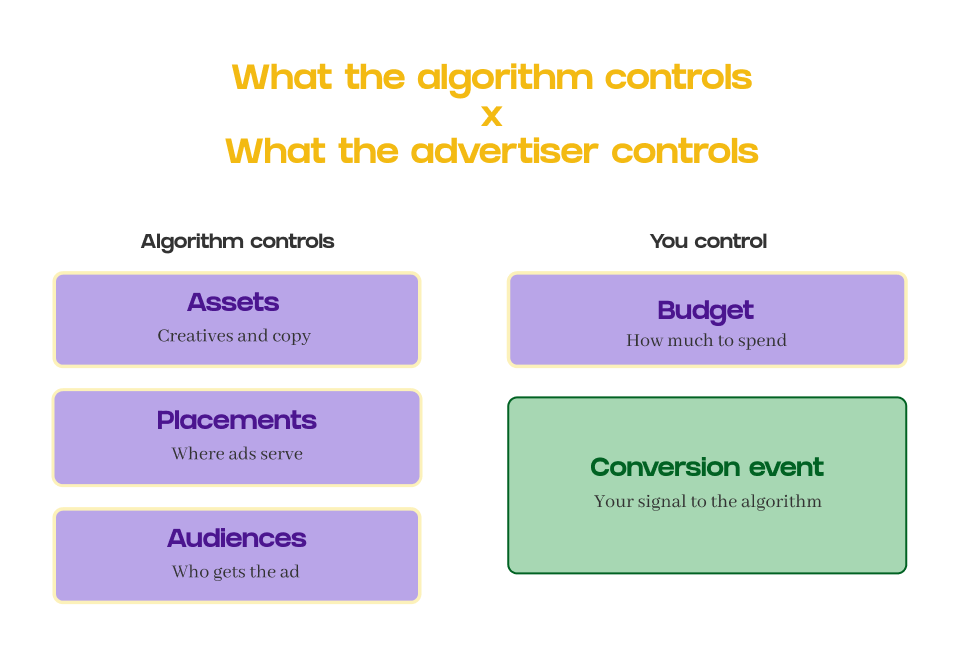
Feed it a weak signal, and it will find users who match that weak signal. Feed it the wrong signal, and it will find the wrong users: efficiently and at scale.
This decision deserves the same strategic attention you give to budgets, channels, and creative. More, probably.
2. The event reflects what success actually means for your business
Not signups. Not form submissions. What does a genuinely good customer look like for your business?
For a nonprofit fundraising platform, a signup is meaningless. The valuable user is one that activates and starts raising money. For a B2B SaaS, it might be an account that invited a second user, or hit a usage milestone that historically predicts retention. For lead gen, it’s not a lead: it’s a qualified lead from the right company size.
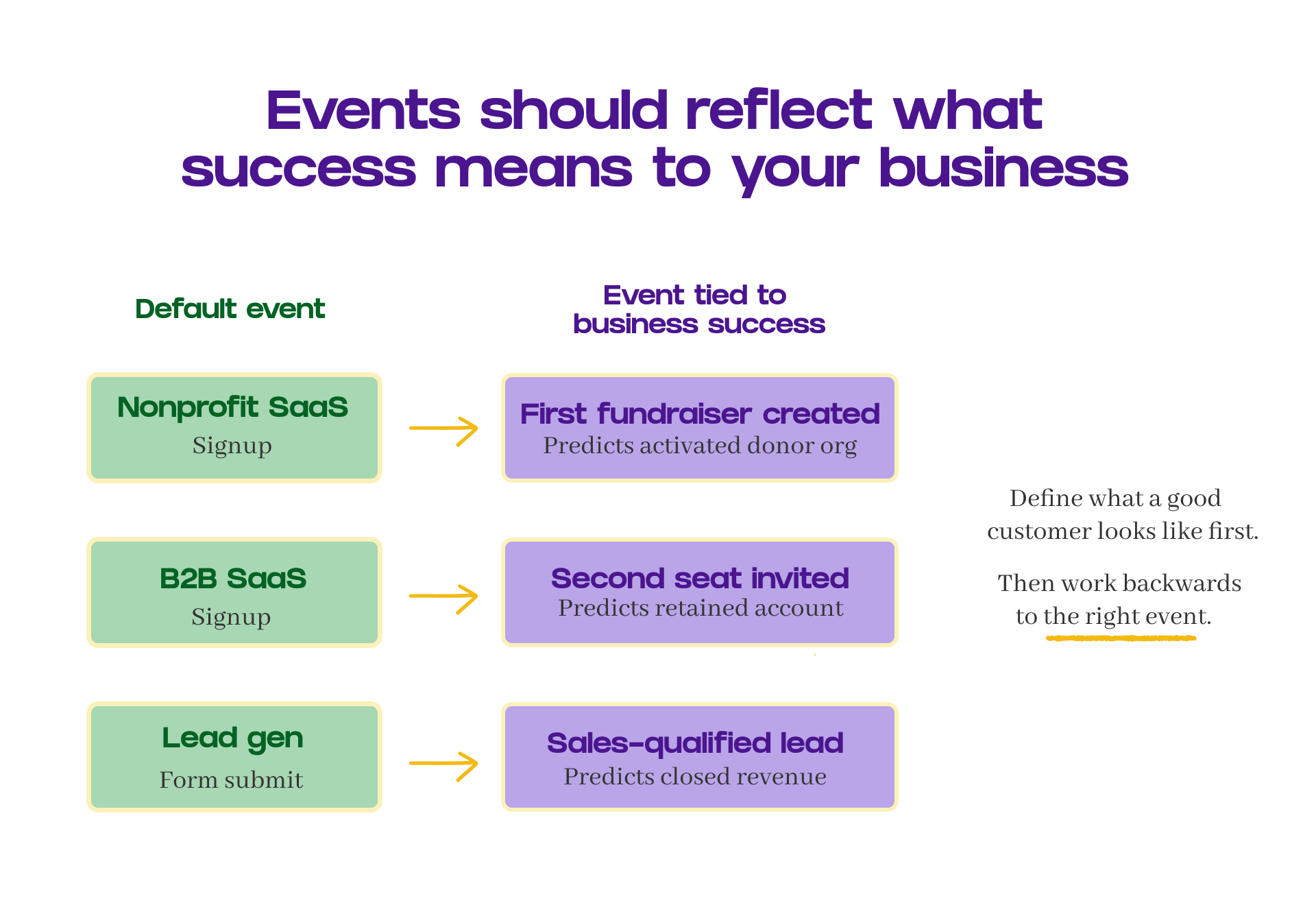
Define that first. Then work backwards to find the right event.
3. The event doesn’t have to be something the user does on your site
This is where most teams leave performance on the table.
Ad platforms accept what’s called a synthetic event: a signal sent directly from your backend or CRM, after the initial online action. The event worth optimizing toward can be something that doesn’t exist in the client at all.
A user fills out a form, but the meaningful conversion is when sales marks them as qualified. A user signs up, but what you want to optimize toward is their first meaningful product action: something that happens in the backend, not in the pixel.
In all these cases, the signal worth sending is computed from data you already have and uploaded via API. Google calls this Offline Conversion Import. Meta receives it through the Conversions API.
4. Events that fire within 24 hours of the ad click have a higher chance of being attributed
Platforms attribute conversions within a lookback window and weight recent signals more heavily. Even though Google can attribute events up to 90 days after a click, a delayed event is a weaker signal. Attribution doesn’t break after 24 hours, but it degrades.
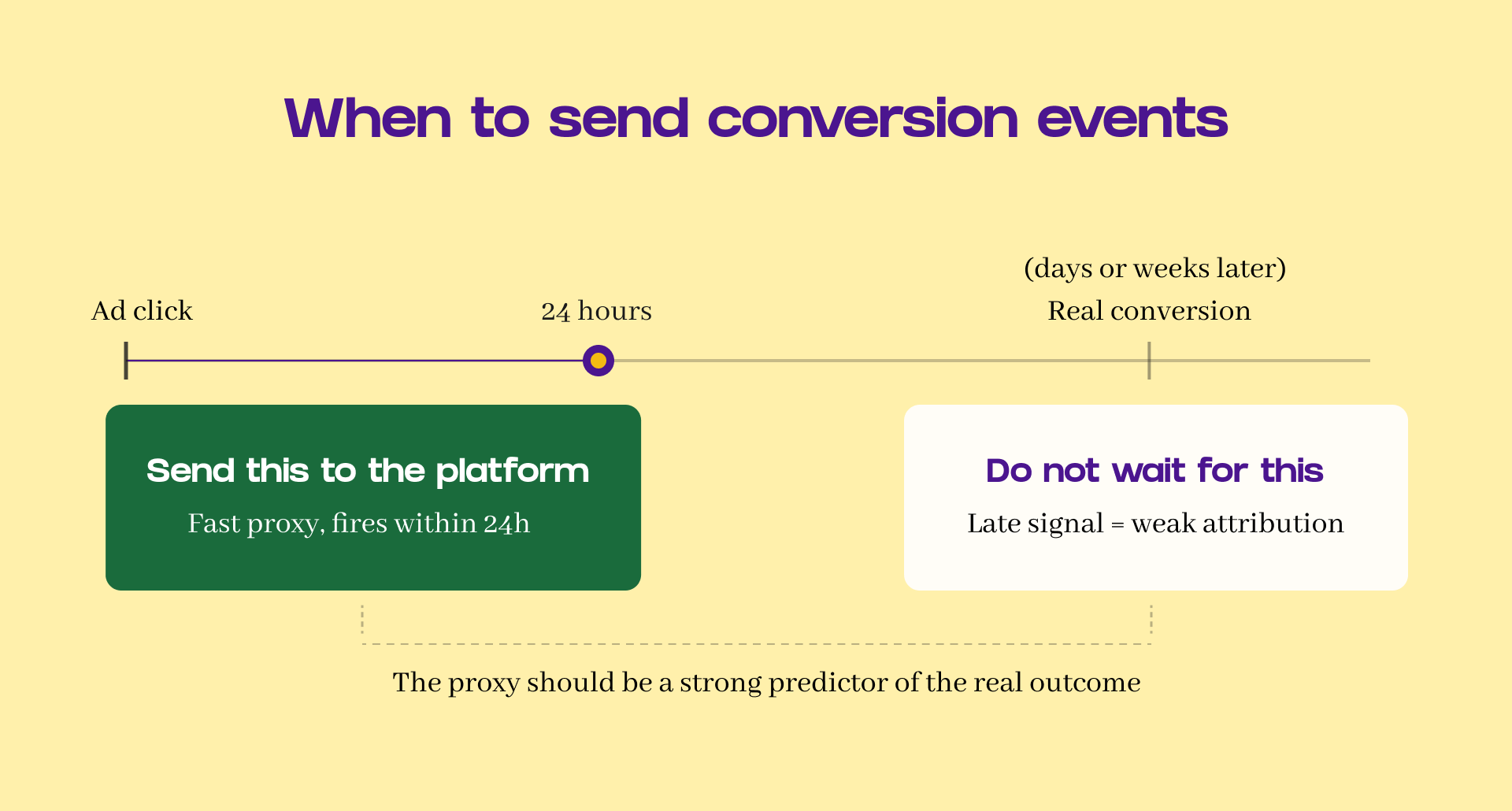
If your real conversion happens later, the solution isn’t to wait. Use a proxy event that fires within 24 hours and is a strong predictor of the downstream outcome you care about. That combination of fast-firing and predictive is better than the real event fired late.
5. Including value data (real or predicted) ensures ad platforms know what customers matter to your business
Without a value field in the payload, every conversion looks identical to the platform. A high-LTV subscriber and a low-intent trialist are indistinguishable. The algorithm optimizes for volume and brings cheap conversions, not valuable ones.
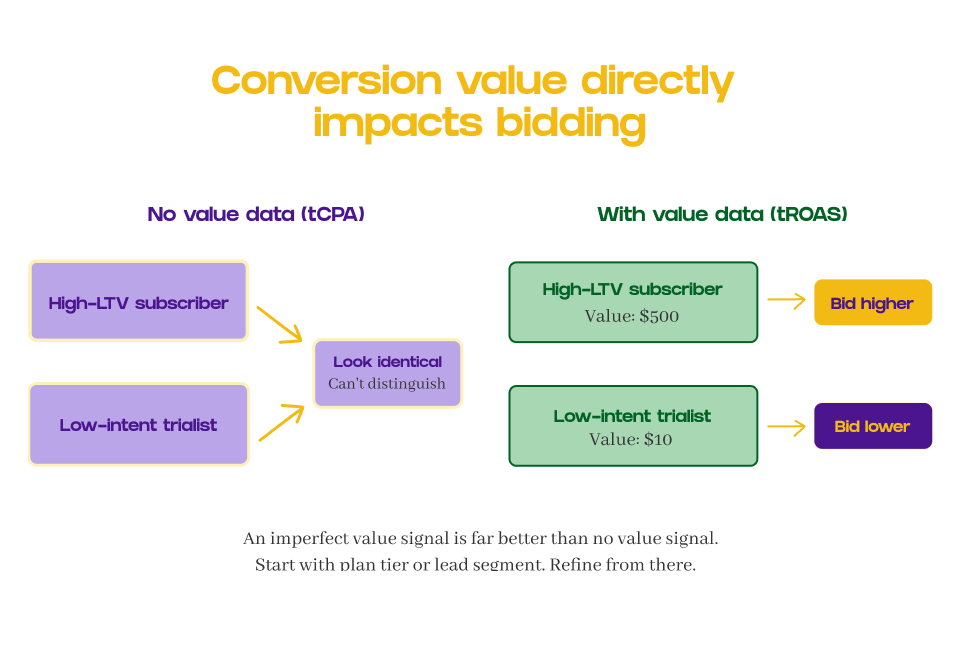
This is the practical difference between tCPA and tROAS. tCPA says: find me conversions at this cost. tROAS says: find me conversions at this return. You can’t run tROAS without value data.
An imperfect value signal is far better than none. You don’t need a model to start. Assigning value by plan tier, lead segment, or company size is enough. Start rough and refine from there.
6. Consent determines how much of the signal the platform can actually use
In markets with low consent rates, events arrive at the platform but can’t be matched back to campaigns for optimization. The event fires. The learning doesn’t happen.
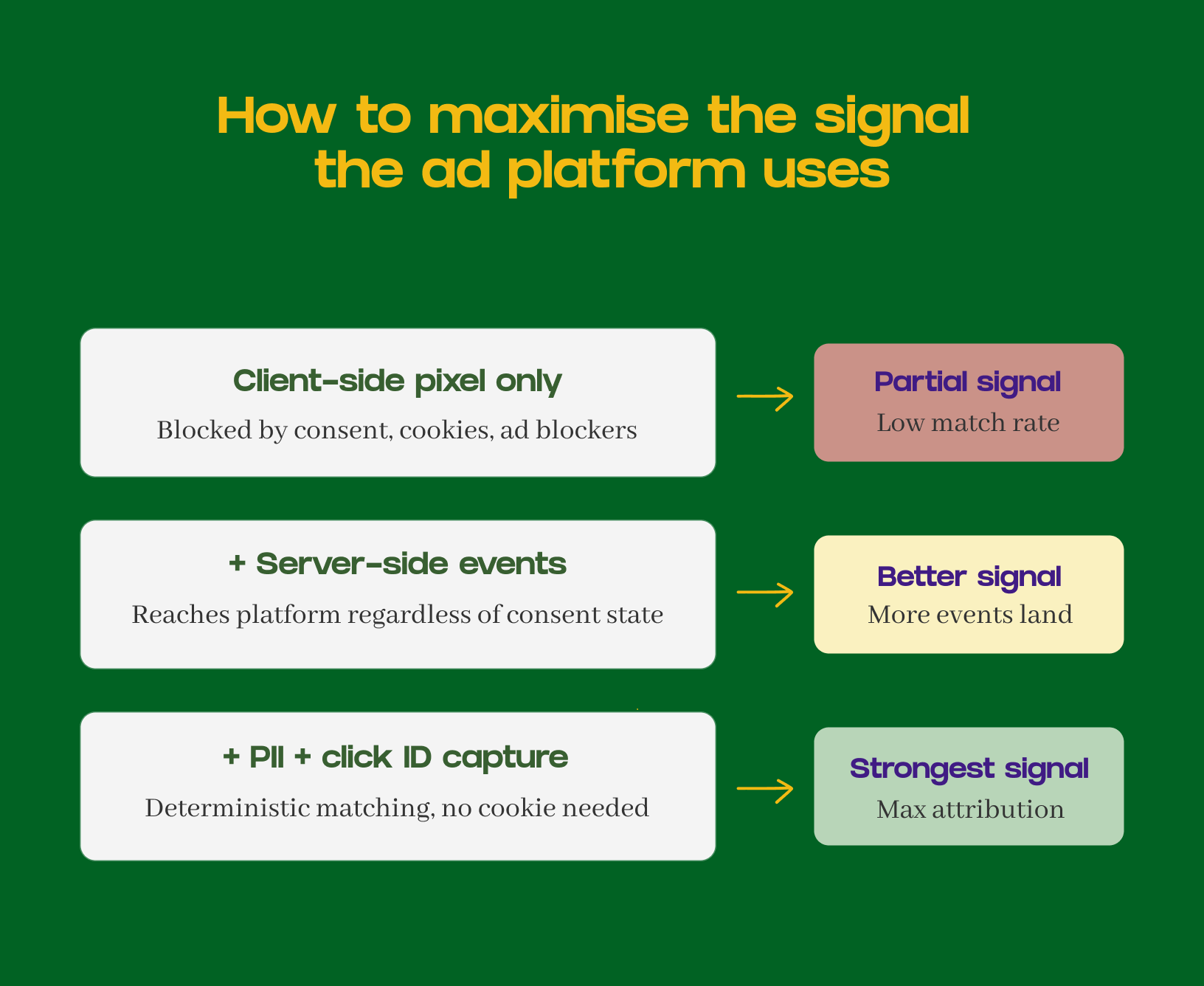
This is not a reason to skip the event or assume tracking is broken. But it is a reason to prioritize server-side over client-side. Server-side events reach the platform regardless of browser consent state, which means more of your signal is actually usable.
7. Passing PII recovers signal that consent and cookies can’t
Hashed email and phone number let platforms match conversions to users deterministically, even when there’s no cookie. It’s the most reliable recovery mechanism available.
This is what Google calls Enhanced Conversions and Meta calls Advanced Matching. The implementation differs by platform, but the principle is the same: the more ways a platform has to identify a user, the more of your conversions it can attribute and learn from.
8. Capturing click IDs guarantees conversions are attributed back to the right campaign
When a user clicks an ad, the platform appends a click ID to the URL: gclid for Google, fbclid for Meta. If you capture and store that ID in your backend at the moment of the initial visit, you can tie any downstream event back to the exact campaign, ad set, and creative that drove it, even if that event fires later.
Without the click ID, the platform is guessing at attribution. With it, the connection is deterministic. User stitching (the process of linking a user’s backend record to their original click ID) can have a significant impact on attribution quality, especially for offline conversions and longer sales cycles.
9. Multiple sources can improve conversion attribution, but beware of duplication
Sending the same event from both client-side and server-side gives better coverage and higher match rates. But without deduplication, the platform counts the same conversion twice and the algorithm learns from inflated numbers.
Reported CAC looks great right up until someone fixes it, and then performance appears to crater. In reality, you were just measuring wrong the entire time.
Always pass a shared event ID across both sources and configure deduplication at the platform level: Meta’s event_id, Google’s transaction_id. QA it before launch, not after the numbers look suspiciously good.
Most teams optimise for the wrong thing and never realize it
The conversion event is not a tracking task. It’s the single input that determines what kind of customer the algorithm goes out and finds. Most teams set it at launch, treat it as infrastructure, and never revisit it. Even as their product, pricing, and customer profile evolve.
Getting it right means starting with a clear definition of what a good customer actually looks like for your business, then working backwards to an event that predicts that outcome, fires fast enough to be attributed, carries value data, and reaches the platform with as much signal intact as possible. That combination is what separates campaigns that improve over time from ones that plateau.
021 is a free newsletter on marketing measurement. If you want to read more about conversion tracking, attribution, and how to use data to improve paid performance, subscribe below.
Thanks for sharing! It's helpful 🙏🙏